Certificate: 15 (strong crude and sexual content, brief male nudity, language and some violent images)
Directed By: Larry Charles
Cast: Sacha Baron Cohen, Ben Kingsley, Anna Faris, John C. Reilly, Jason Mantsoukas, Fred Melamed, Bobby Lee, Megan Fox
Budget: $65 million
Runtime: 83 minutes
Trailer: Watch
When the childish, misogynistic, torturous Admiral General Aladeen (Cohen), supreme leader of oil-producing, uranium-enriching Wadiya is summoned to the United Nations to explain his nuclear weapons programme, he sees it as the perfect opportunity to waggle his finger at self-righteous Westerners. But when his uncle and 'rightful' leader Tamir's (Kingsley) assassination attempt doesn't go to plan, Aladeen finds himself wandering the mean streets of Brooklyn with only Zoe (Faris), an ultra-liberal vegan feminist, for companionship.
With Sacha Baron Cohen now an internationally recognised face the undercover verite of Ali G, Borat and Brüno are now a thing of the past for the former incognito shit stirrer. Cohen has consequently gone back to the drawing board and created Aladeen, a murderous yet infantile tyrant, but a character framed in a traditionally scripted structure. Unwilling to completely relinquish the idea of exposing people's bizarre behaviours, Larry Charles, famed creator behind Seinfeld and Curb Your Enthusiasm, has been drafted to transfer the same comic technique here. However, putting this sheer imbecile infront of very serious UN dignitaries doesn't quite yield the same effect when reactions are scripted. Indeed, despite both Cohen and Charles' livings having been made on perceiving humanity's absurd quirks and exposing their prejudices, no attempt to translate their trade can mask how formulaic and controlled The Dictator is.
Admiral General Aladeen is the most implausible of characters. In many ways he satirises every peculiarity dictators throughout history seem to exhibit. Idi Amin for example consulted on issues with the severed heads of executed cabinet ministers, and in 1977 gave himself the grandiose title of ‘His Excellency, President for Life, Field Marshal Al Hadji Doctor Idi Amin Dada, VC, DSO, MC, Lord of All the Beasts of the Earth and Fishes of the Seas, and Conqueror of the British Empire in Africa’. Kim Jong Il (the late North Korean leader to whom this film is dedicated to) also had some funny ideas. In the late seventies he kidnapped the South Korean 'Orson Welles', imprisoning him for four years while feeding him nothing but grass in a bid to rejuvenate his country's film industry. Likewise Saddam Hussein, the man who claimed to be a descendent of the Prophet Mohammed, lived in opulent palaces that even Aladeen's garish tastes do no justice to while Gaddafi and the Admiral General quite clearly share the same tailor. And let's not mention Bin Laden, whom Aladeen has locked in his basement. But despite this persona, a patchwork 'homage' to some of history's most despicable yet strangest men, Aladeen isn't nearly as funny as he appears. His one-liners are pretty stale in this day and age, almost strained. As much as Cohen tries to recreate the 'oh no you didn't' moments which made him famous, The Dictator is unashamedly manufactured 'boundary pushing'. As controversial as it tries to be, nothing here will truly shock you. Yes, Aladeen recreates the Munich massacre on his Wii, but nothing ever really feels risque, even if supplemented by an inordinate amount of sexism and rape jokes. All this spirals around a very strange romance tale from a man who merely wants a cuddle, inviting one to think that if only the murderous bastards throughout history had been loved they might not have turned out so mean.
The Dictator is a case of old-hat culture clash and stereotypes, indiscriminately taking pot shots at ethnicities accompanied by a plethora of misogyny all disguised in the ignorance of Aladeen himself. The question ultimately posed by The Dictator is whether it is simply a crass, boorish effort (something I have no conceptual qualms over), or a genuinely tasteless, and perhaps even offensive film. The cloak of irony is one often worn by those making socially taboo jokes, and sometimes they are genuinely meant as such. The problem is that such a veil can be incredibly thin. Are we really laughing at Aladeen's 'mockery' of sexism? Well, if you say so. But can one really attest to that same shield of irony over jokes about the dictator's partiality for raping prepubescent boys who all committed suicide afterward? Certainly this 'gag' caused no ripple in the audience I sat in, but when Zoe was revealed to be living up to the feminist stereotypes of having hairy armpits you can be sure the theatre was awash in gasps of amusement and disgust. Of course one could counter that Cohen's brand of barbed humour has always been delivered with a heavy hint of mordancy, citing examples of Borat and Brüno as being no different. But there is a distinguishable distinction between those and The Dictator. While on the surface the outrageous humour might appear similar here, the audiences of Cohen's past works were laughing at something entirely different. Indeed, they were invited in on the joke, fully aware that these characters were idiots, laughing with him as he exposed the fools who took him at face value. It worked because this seemingly hapless fool would stumble around interviewing "genuine chocolate faces" who never cottoned on that Cohen was in actuality a guileful satirist. We sneered at those who revealed their own bigotry while simultaneously massaging our egos by telling ourselves we'd never fall for that. In a way it was kind of sick, but it was laughter you could emerge from guiltless. In Aladeen however Cohen isn't fooling anyone, its traditional movie structure discrediting the privilege of plausible deniability regarding our own prejudices. The 'oh, it's just a joke' line doesn't sit so easily in this format.
While its humour remains precarious the other point of note regarding all this is that given the many contemporary issues it touches upon, 'politics' was always going to rear its head. Perhaps disappointingly The Dictator only wades in to its ankles, squandering a lot of its potential political poignancy. It does flirt with such ideas, notably in its climax where Aladeen argues the benefits of dictatorship over democracy, but otherwise fails to follow through by interjecting rabble-rousing inanity into proceedings. "You could let 1% have 90% of the wealth" decrees Aladeen, painting a vision of if America were a dictatorship. "Your media would appear free but be secretly controlled by one person and his family!". Yet this joke, the sharpest in the film by far, seemed lost on the audience which might explain why The Dictator seems so reluctant to push any political point. Ironically holding the American system up to the light of scrutiny and the similarities to those regimes it decries evidently wasn't funny. But you can be sure as hell that not five-minutes before were my fellow moviegoers in hysterics at Aladeen shitting from a zip-line. And yet this little speech is what the film had been working up to; everything which preceded this moment existed merely to set up this political punchline. It takes an awfully long time to lead up to this moment, and sitting through it all isn't always enjoyable.
The Dictator never seeks to confront anything. Rather, it chooses to conflate and compound stereotypes. Yes, there is some political point in there somewhere highlighting the real reasons for the West's penchant for deposing dictators while turning a blind eye to their own foreign policy record, but Aladeen's enmity moots all this. Indeed, the adherence to farce in favour over satire almost signifies a lack of confidence in its audience. The Dictator lacks the surrealist anarchy of Cohen's earlier works. It is juvenile, ramshackle and graceless; none of which make for great raillery. After all, satire is funny because it's true. This is just absurd.
Showing posts with label Anna Faris. Show all posts
Thursday, 7 June 2012
Monday, 9 January 2012
Film Review: What's Your Number?
What's Your Number? is a mashup of recent romcoms like Bridesmaids and Friends With Benefits featuring a girl unlucky in love who has some bizarre secret creative talent which turns out to be her true calling in life and a big soppy 'you're the one' speech at the end. You can expect every cliche in the book here and the outcome is inevitable where from the first moment Colin appears onscreen you just know he'll be lucky number 21. To be fair to this however it does have its comic moments in spite of its banality. There are laughs to be had as Ally ambushes her ex lovers, particularly one involving a puppeteer played by Lonely Island star Andy Samberg. However Ally's trip down memory lane does nothing toward understanding where she went wrong in the past nor teach her any lessons about her own inability to form lasting relationships. Indeed, one might expect a little introspection from a film of this nature.
Still, Faris is charming enough with her infectious enthusiasm but it is the permanently topless Evans who injects most into proceedings. While both are likeable, their blossoming romance dogmatically follows every trope in the genre. Perhaps the best thing about What's Your Number? however is how ironically nonchalant it is, despite its rigid adherence to the romantic comedy formula. Yes, it's stale, but it remains breezy and light mostly throughout. That is until things start to get particularly tedious toward the end where a wedding setting sees proceedings devolve into a shameless chick flick as Ally must choose between two handsome men. It also goes on for far too long where the most galling number of all is not how many men Ally has slept with but the film's runtime.
While this might strike a chord with the modern woman's concerns, this is more trite than anything else. Ultimately however it is inoffensive and while there's a twinkle from its affable stars, the concept has been done to death. As such this is more a disposable giggle than a self-affirming simulacrum for all the single ladies out there.
Thursday, 7 July 2011
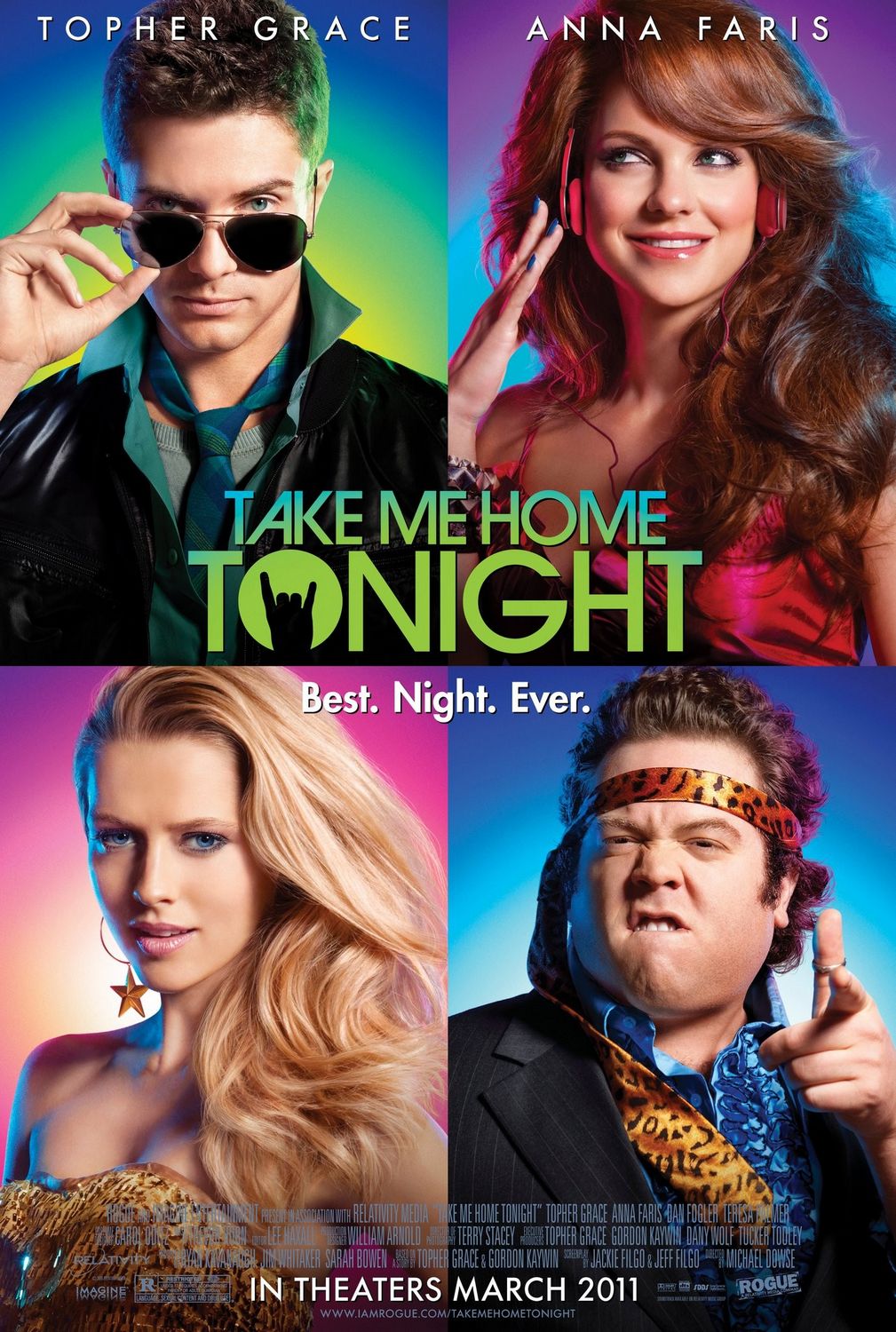
Film Review: Take Me Home Tonight
Society expects your life to follow a path of orderly progression; finish school, get a career and have a family, only to eventually retire and be supported by the next generation who will do exactly the same. However, this traditional cycle appears to be breaking as young twenty-somethings delay the transition from childhood to adulthood. Sociologists have dubbed this phenomena the 'changing timetable for adulthood'. It is this tenet which Take Me Home Tonight flirts with, a film that has been shelved since 2007 allegedly for its portrayal of recreational cocaine use.
Matt Franklin (Grace) has just graduated from MIT with a degree in engineering. Returning home to LA and living with his parents, Matt works in a video-rental store while he waits for his future to clarify itself. When he re-encounters his unrequited high-school crush, Tori (Palmer), he lies about working at Goldman Sachs to impress her - despite there not being a branch in LA. Still smitten, Matt follows her to an end-of-summer party hosted by his sister's (Faris) yuppie boyfriend, accompanied by his derelict best-friend, Barry (Fogler), in what promises to be one hell of a night.
At its heart, Take Me Home Tonight is about a kid so frightened of putting a foot wrong in life that he collapses into a ball of inertia. It's not necessarily a new concept; eighties classics such as Ferris Bueller's Day Off and The Breakfast Club, and more recently Adventureland, hit upon similar themes of directionless youth. However, there are a couple of particularly poignant scenes which hit closer to home than others have done. Take Me Home Tonight fails though on the understanding that, foremost, this is supposed to be a comedy. That's not to say it isn't 'funny', but it generates more of a subdued amusement rather than continuous laugh-out-loud moments. This is mainly due to a dialogue which is not as sharp as it perhaps could have been and a poor execution of otherwise sound scenarios.
Grace and Palmer don't sparkle, but they do nonetheless make a good pairing in that generic kind of way. Their relationship is about as formulaic as you can get in a rom-com, falling prey of that tried and tested device of romance, crisis and reconciliation. It is a grand tradition in films of this nature for the main lead to engineer a ridiculous scenario to impress a love interest, only for the end of the second act to have that obligatory moment of confession. Cue the third act of trying to save lost love. As for Matt's comic foil, Fogler is more than adept at the bawdy role. However, you do get the sense that the part of 'fat cretin' is becoming an overcrowded market with the likes of Jonah Hill and Zach Galifianakis having pretty much made the role their own. How many more of these will Hollywood churn out?
Upon first glance this might be a film that will appeal to the nostalgic forty-something demographic. In reality however it is not a film for those brought up immersed in eighties pop-culture. Rather it is a 'nostalgia'-fest for those who missed the boat the first time round and who now spend their time in clubs which put on 80s retro nights. Indeed, what really holds this film together is its induced nostalgia riveted with a fantastic soundtrack. Choices such as Kim Carnes' 'Bette Davis Eyes' and Duran Duran's 'Hungry Like The Wolf' do brilliantly to work succinctly with the mood and time of the film. Ironically however it doesn't feature the Eddie Money hit after which it was named.
But it takes more than a great soundtrack to make a great movie. To be fair, Take Me Home Tonight does well to capture the eighties yuppie culture of cocaine, fast cars and coveted materialism. It's setting and themes may well resonate with the twenty-somethings of today, but it remains precariously balanced on the edge of failure as a comedy.
Subscribe to:
Posts (Atom)