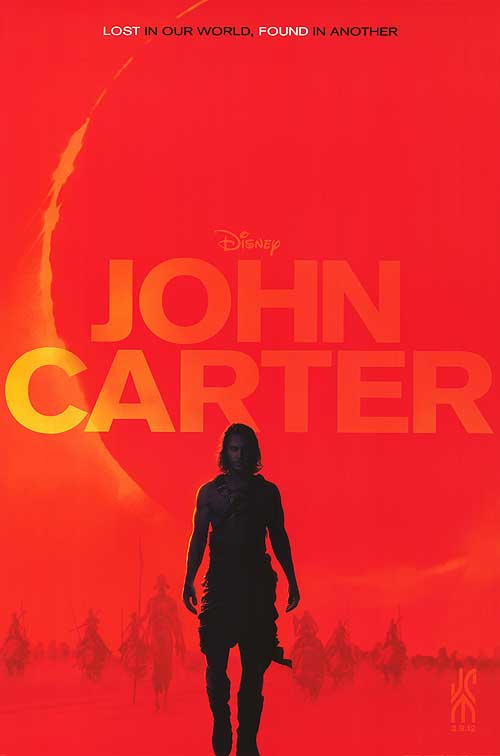
Certificate: 12A (intense sequences of violence and action)
Directed By: Andrew Stanton
Cast: Taylor Kitsch, Lynn Collins, Mark Strong, Willem Dafoe, Samantha Morton, Thomas Haden Church, Ciarán Hinds, Dominic West, James Purefoy, Polly Walker, Bryan Cranston
Budget: $250 million
Runtime: 132 minutes
Trailer: Watch
John Carter (Kitsch) is a world-weary civil war veteran who goes looking for gold in the Apache territories. Upon stumbling into a cave he finds a mysterious amulet which whooshes him off to Mars - or as the natives call it, Barsoom. There Carter quickly discovers he has super strength and can leap a hundred feet into the air. He is taken in by rather primitive green martians called 'Tharks' who are caught in the middle of two warring, red-tinged humanoid factions. These are the tyrannical Zodangans and those of the last free city of Helium. When he saves the beautiful Heliumite Princess Dejah (Collins), pacifist Carter finds himself sucked into the conflict.
This is of course a shamelessly overt parallel to the 1880s Earth from which Carter just arrived, neatly summed up by the Thark leader Tars Tarkas (Dafoe) who says "let red men kill red men until only Tharks remain". The analogy is clear; the Tharks represent the Native Americans while the Zodangans and Heliumites are the Confederate and Union sides of America's civil war. But that's about as deep as this gets. The Tharks aren't being pushed out of their lands and subject to extinction by the red man, rather they're left quite to their own devices. Certainly John Carter's allegory isn't quite as poignant as the one in Cowboys & Aliens, even if it was sanitised for American audiences. While this all sounds pretty simplistic, Andrew Stanton's adaptation of Edgar Rice Burrough's novel does much to confuse its audience. There's Therns, Tharks, ninth rays and everything else therein which doesn't bode well for artistic coherence. Just what the hell is a ninth ray isolate? Who are these Therns which resemble 'the observers' from Fringe? What is their role in all this? Well, John Carter certainly won't pretend to give you the answers.
Convoluted plots aren't the only problem with John Carter. For starters some of the dialogue is pure cringe. In an appeal to Carter's emotions, Dejah emphatically begs "Will you stay and fight - for Helium?!". Later, rallying his troops, Carter cries "If Helium falls, so does Barsoom!". One can't help but wince. The battle scenes, although pretty, nonetheless feel somewhat lacklustre. They are short and to the point, but not as epic as you might expect from a film this grandiose in ambition and budget. This is particularly the case with the final showdown where one really doesn't get the impression it is the battle to decide the fate of the planet. More so, it looks and plays out like an abridged version of what went down at the end of Flash Gordon. In fact, everything in John Carter seems compressed, which is strange given its punishing runtime. This is overly long without reason, and doesn't make adequate use of the time to develop its plot strands. The result is that it remains desultory, bland and difficult to follow, emitting a peculiarly heavy feeling for a Disney action film. This isn't helped by a script which shies away from wit and lacks the fun of other Disney titles in the same bracket, namely Pirates of the Caribbean.
Indeed, most surprising of all is how extraordinarily violent this is for a Disney movie. You see, I was brought up on a diet of Aladdin and the Lion King where the clear distinction between good and evil was drawn. By the end of the movie, peace and love would always triumph and the few deaths which did happen were portrayed tactfully for their younger audiences. Here, hacking and slashing is common place in a world where there is no pussyfooting around death. In one scene after a tumultuous battle we see the victors piling corpses in a neat little stack. Is this the Disney I remember from childhood? More importantly, is this fitting for a 12A rating? While I still get a warm fuzzy feeling and an invigorated sense of hope and optimism whenever I watch a Disney film from my childhood, it is a wonder if this 'new direction' for the company is going to result in a generation desensitised to violence and shrouded in moral ambiguity.
Perhaps most disappointingly however are the film's two lead roles. Kitsch is pretty impassive for an action hero and borders on vapid. The only emotion you'll get out of him is if you attempt to restrict this man's liberty. Pray you don't, else you'll see a fully grown man morph into a toddler who literally kicks and screams until he gets his way. Despite her sexy muscular thighs, Collins isn't much more enlivening. Princess Dejah is just straight up confused. One moment a brilliant scientist, the next a fearsome warrior heroin not afraid to go balls deep, only to become your traditional ditzy damsel in distress. Unfortunately you can't be all of them, love, and it is this which makes her character unsympathetic altogether. More incredulous is the two's budding romance where within a mere five minutes the two are madly in love. It's a difficult one to swallow, especially as the two are shown to be constantly wary, tiptoeing around one another for fear of intruding on the other's space.
At least John Carter is very visually impressive. This might be expected given that Stanton, the man involved with Pixar greats such as Toy Story and Wall▪E, is at the helm. There's motion-captured Tharks, airships which resembles dragonflies and arresting vistas of a sparkling Helium. If anything else, this is stunning to look at. And it may as well be given its obscene budget of $250million, which exceeds even that of Marvel's The Avengers. However, for all its visual splendour it is everything else which lets John Carter down, which is shown in losses of $200million (£126million) due to poor box-office results. Granted, it hardly has the most awe-inspiring titles but what's more puzzling however is that for all its CGI magnificence it's difficult to tell where else this absurd amount of money has been spent on what is a very niche adaptation, even for the nerd community. John Carter stars names which skirt the periphery of Hollywood, mostly British actors who are notoriously hired based on their relative 'cheapness' vis-a-vis their American colleagues. Indeed, they are hardly paying a cohort of Brad Pitts and Angelina Jolies here.
Despite Disney ploughing enough money into John Carter to solve world hunger, the end result falls way short of expectations. At best it might be considered a passable action adventure, but a convoluted storyline, made more confusing by a bunch of absurd names do much to undermine what is otherwise an aesthetically pleasing film.
Showing posts with label Bryan Cranston. Show all posts
Sunday, 27 May 2012
Thursday, 15 December 2011
Film Review: Contagion
Hollywood has been through just about every permeation of potential causes for man's demise. From asteroids to nuclear war, killer bees to volcanoes, polar shifts to alien invasions, now it would seem that viruses are flavour of the week. Even the current pop-culture fascination with zombies invariably begins with some nasty little germ mutation. And what with recent scares over H1N1, bird flu and SARS serving to whip up a panicked frenzy, it seems fitting then that a film posit 'what if the wrong pig met up with the wrong bat?'. What if the result was some sort of pig-bat virus, transmitted through touch and able to claim your life in a matter of days? Contagion attempts to provide the answer.
When an unknown deadly virus begins knocking off seemingly random people around the globe, authorities race against time to track the source of the contagion and find a cure. Meanwhile a man (Damon) must deal with the sudden deaths of his wife (Paltrow) and son-in-law as society breaks down and an internet conspiracy theorist (Law) blogs myths of a cure which only serves to exacerbate the panic.
This is your typical 'what if' scenario similar in vain to 1980s disaster movie The Day After and global warming/cooling/whatever doomsday effort, The Day After Tomorrow. Like those, Contagion's grounding in reality can be a rather frightening prospect. An unseen killer, easily transmitted, accentuated by director Steven Soderbergh's lingering shots of touched doorknobs and surfaces for a few seconds longer than necessary. We are introduced to cities with their population totals flashed at the bottom of our screen while bodies are piled into massgraves and the death toll rises. And yet, Contagion never gives the impression that this disease is all that deadly. While the film's globe-trotting exploits are supposed to give you a sense of scale and magnitude, we aren't really given any stats as to how many people the virus has claimed. There is a snippet which mentions that, after a year, 2.5million have died in the US, but this represents only 1% of the US population. If we were to scale this out and assume that figures were similar in the rest of the world then it doesn't seem as unbearable as the film suggests. That may sound callous but if you take one of the most deadly natural disasters in human history, the Spanish flu which killed some 10% of the world's population back in 1918, this virus seems relatively small fish in comparison.
Indeed, fears can be further allayed when I read that the virus in Contagion isn't exactly scientifically accurate either. While the disease in the film is highly lethal, infects large amounts of people and has a very short incubation period, the reality is somewhat further removed from such a scenario. In reality an infectious disease must have a relatively long incubation period and less lethality than the film propositions in order for the virus to continue to spread. Consequently tracking the disease, which is a central plot point in Contagion, is much more difficult than the film suggests. As such many facts had to be bent in order for the story to work, and so Contagion's premise perhaps not as frightening as it first suggests.
More frightening though is the societal effects of the virus. As authorities fail to contain the outbreak and food riots ensue, people begin looking to alternative sources for guidance. Cue Jude Law's Alan Krumwiede, a conspiracist blogger claiming the government are in on it all and that the only cure is a homeopathic medicine called 'Forsythia'. Inevitably panic spreads in a fashion which seems more contagious than the virus itself as people loot pharmacies in search of this miraculous placebo. As many of us get our information from the internet these days we often forget that not all of it is vetted and corroborated. The internet is essentially a double-edged sword, both doing wonders for the proliferation of information yet burdened with an equal capacity to transmit dangerous myths and rumour. With regards to Krumwiede he quite evidently has a screw loose but what's more interesting is how the film paints him as the 'bad guy', embodying everything 'unAmerican' from dodgy accent to bad teeth. And yet Krumwiede raises some interesting points about pharmaceutical companies creating crises in order to profit as well as the unforeseen consequences of vaccines such as autism or the swine flu shot which actually killed people back in 1976. Yes he misleads people and hypocritically uses the situation to his advantage in the same vain he accuses big pharma of by becoming a modern day snake-oil salesman, but the ad-hominem portrayal of a paranoid, anorak-wearing crack-pot acts to invalidate some perfectly reasonable questions. The fact that he's Australian could also allude to another infamous Aussie whistle-blower that authorities have had a problem with lately, one Julian Assange.
Perhaps Contagion's biggest problem however is that its all star cast and jumping all over the world doesn't leave much room for showcasing their talent. Nor do you really get the time to build an empathetic relationship with their characters where you probably won't really care which Hollywood superstar snuffs it next. Damon's everyman isn't really afforded the opportunity to capture grief very well as he quarantines himself and his daughter inside their house for the majority of the film while Winslet promises spunk but is sold short just as soon as she sparks interest. Cottilard's WHO (World Health Organisation) epidemiologist meanwhile is given perhaps the most dramatic story arc yet it is one the film shafts right until the end. So much so in fact that it needn't have been even incorporated into the script. Only is the CDC (Centre for Disease Control) head-honcho, played by Laurence Fishburne, given any sort of multi-faceted depth, embodying the same human fallacies of self-interest, stupidity and arrogance as the rest of us. Indeed, it is these three facets alluded to throughout the film which are more scary than any killer-virus could be. Moreover though the briskness with which Contagion shoots over everything, while admittedly serving well to create a fluidity of event, also unfortunately sacrifices character development for something which looks much more like a documentary.
But then, this is the nature of the beast where globe-trotting films are invariably driven more by events than characters. And yet, it still feels like a disappointing waste of talent, even a gimmick to pull in audiences. Everything would have worked exactly the same had its characters been played by just about anyone else. Consequently Contagion is a film without sympathy, as clinical as its scientists who scramble in their lab for a cure. Like the humans involved here it's not perfect, but if you're into your apocalyptic scenarios you might want to give this a go. Preferably with a face mask.
When an unknown deadly virus begins knocking off seemingly random people around the globe, authorities race against time to track the source of the contagion and find a cure. Meanwhile a man (Damon) must deal with the sudden deaths of his wife (Paltrow) and son-in-law as society breaks down and an internet conspiracy theorist (Law) blogs myths of a cure which only serves to exacerbate the panic.
This is your typical 'what if' scenario similar in vain to 1980s disaster movie The Day After and global warming/cooling/whatever doomsday effort, The Day After Tomorrow. Like those, Contagion's grounding in reality can be a rather frightening prospect. An unseen killer, easily transmitted, accentuated by director Steven Soderbergh's lingering shots of touched doorknobs and surfaces for a few seconds longer than necessary. We are introduced to cities with their population totals flashed at the bottom of our screen while bodies are piled into massgraves and the death toll rises. And yet, Contagion never gives the impression that this disease is all that deadly. While the film's globe-trotting exploits are supposed to give you a sense of scale and magnitude, we aren't really given any stats as to how many people the virus has claimed. There is a snippet which mentions that, after a year, 2.5million have died in the US, but this represents only 1% of the US population. If we were to scale this out and assume that figures were similar in the rest of the world then it doesn't seem as unbearable as the film suggests. That may sound callous but if you take one of the most deadly natural disasters in human history, the Spanish flu which killed some 10% of the world's population back in 1918, this virus seems relatively small fish in comparison.
Indeed, fears can be further allayed when I read that the virus in Contagion isn't exactly scientifically accurate either. While the disease in the film is highly lethal, infects large amounts of people and has a very short incubation period, the reality is somewhat further removed from such a scenario. In reality an infectious disease must have a relatively long incubation period and less lethality than the film propositions in order for the virus to continue to spread. Consequently tracking the disease, which is a central plot point in Contagion, is much more difficult than the film suggests. As such many facts had to be bent in order for the story to work, and so Contagion's premise perhaps not as frightening as it first suggests.
More frightening though is the societal effects of the virus. As authorities fail to contain the outbreak and food riots ensue, people begin looking to alternative sources for guidance. Cue Jude Law's Alan Krumwiede, a conspiracist blogger claiming the government are in on it all and that the only cure is a homeopathic medicine called 'Forsythia'. Inevitably panic spreads in a fashion which seems more contagious than the virus itself as people loot pharmacies in search of this miraculous placebo. As many of us get our information from the internet these days we often forget that not all of it is vetted and corroborated. The internet is essentially a double-edged sword, both doing wonders for the proliferation of information yet burdened with an equal capacity to transmit dangerous myths and rumour. With regards to Krumwiede he quite evidently has a screw loose but what's more interesting is how the film paints him as the 'bad guy', embodying everything 'unAmerican' from dodgy accent to bad teeth. And yet Krumwiede raises some interesting points about pharmaceutical companies creating crises in order to profit as well as the unforeseen consequences of vaccines such as autism or the swine flu shot which actually killed people back in 1976. Yes he misleads people and hypocritically uses the situation to his advantage in the same vain he accuses big pharma of by becoming a modern day snake-oil salesman, but the ad-hominem portrayal of a paranoid, anorak-wearing crack-pot acts to invalidate some perfectly reasonable questions. The fact that he's Australian could also allude to another infamous Aussie whistle-blower that authorities have had a problem with lately, one Julian Assange.
Perhaps Contagion's biggest problem however is that its all star cast and jumping all over the world doesn't leave much room for showcasing their talent. Nor do you really get the time to build an empathetic relationship with their characters where you probably won't really care which Hollywood superstar snuffs it next. Damon's everyman isn't really afforded the opportunity to capture grief very well as he quarantines himself and his daughter inside their house for the majority of the film while Winslet promises spunk but is sold short just as soon as she sparks interest. Cottilard's WHO (World Health Organisation) epidemiologist meanwhile is given perhaps the most dramatic story arc yet it is one the film shafts right until the end. So much so in fact that it needn't have been even incorporated into the script. Only is the CDC (Centre for Disease Control) head-honcho, played by Laurence Fishburne, given any sort of multi-faceted depth, embodying the same human fallacies of self-interest, stupidity and arrogance as the rest of us. Indeed, it is these three facets alluded to throughout the film which are more scary than any killer-virus could be. Moreover though the briskness with which Contagion shoots over everything, while admittedly serving well to create a fluidity of event, also unfortunately sacrifices character development for something which looks much more like a documentary.
But then, this is the nature of the beast where globe-trotting films are invariably driven more by events than characters. And yet, it still feels like a disappointing waste of talent, even a gimmick to pull in audiences. Everything would have worked exactly the same had its characters been played by just about anyone else. Consequently Contagion is a film without sympathy, as clinical as its scientists who scramble in their lab for a cure. Like the humans involved here it's not perfect, but if you're into your apocalyptic scenarios you might want to give this a go. Preferably with a face mask.
Thursday, 1 December 2011
Film Review: Drive
The plot is about as conventional as you can get, but that's not why Drive is great. It's stylish visuals and retro-80s feel coupled with a fantastic script and performances are what makes this a winner. What's more amazing about Drive though is how precariously it sits on the edge of failure. Had it been any director other than Nicolas Winding Refn then this could so easily have fallen flat on its otherwise engaging exploitation of garish tropes. Gosling, who also produced the film, made a sound decision in bringing the Danish director on board which was clearly exemplified by his Best Director Award at Cannes this year. Certainly, this is one of those few films where style triumphs over substance, no more immediately evident than in its opening scene. 'Driver' performs a seemingly impossible getaway for a couple of armed robbers, effortlessly evading police without so much as breaking a sweat. It is truly one of the most thrillingly intense scenes put to film this year and proves to be absolutely hypnotic. Cutting to opening credits we are engulfed by Drive's second greatest asset, an invigorating 80s synth tribute which plays us in as pulsating pink neon font resembling that in 80s classic, Cocktail, overlay incredible panoramic shots of LA. Drive is certainly one stylish film.
It is Gosling however who proves to be the star attraction, whose role could easily have been filled by any one of the generic macho brutes Hollywood has to offer. But this would have been the wrong option, a choice which almost certainly would have plunged Drive into inanity. Fortunately Gosling is perfectly cast, his Ohio-farm boy good looks serving to accentuate the tension of what's going on underneath the surface. Wary and softly spoken, Gosling remains an enigma throughout the film which works in tandem with his almost vacant expression as his awkward, superficial attempts to interact with people scream a sense of alienation. There's also a very noble quality to 'Driver', as well as a romantic side. When he meets neighbour Irene the two begin hanging out, her son immediately warming to him as he takes them on a day trip to a river bank while the soundtrack informs us that "he's a hero, a real human being". Despite 'Driver' barely able to string two words together, Irene develops a crush and the two begin exchanging the most tender of looks and half-smiles. Even when Irene's husband is released from prison our 'Driver' doesn't just accept him but becomes his protector too, getting involved in a gang-dispute which has nothing to do with him.
And yet, this seemingly gentle man is anything but as he shifts from being very calm, quiet and deliberate in his actions to moments of explosive violence in a play between indolence and swiftness. Revealed to be harbouring a savage passenger, Dexter fans will no doubt love this. Here we have a man seemingly determined to protect the innocent while struggling against an appetite for salacious violence. The most stark juxtaposition between the 'Driver's' two sides comes when he passionately kisses Irene in a lift before immediately descending into a brutal attack on an assassin while she looks on in abject horror. Indeed, Drive's graphic violence has proved to be a talking point among critics, described as "shocking" and "grotesque" by many. Admittedly it's not as frequent as some analysis might have you believe, but what is shown is particularly pitiless. From fisticuffs to razor blades and hammers, Drive will undoubtedly make you wince. However, if we analyse Drive's most gruesome portrayal of brutality, a scene where 'Driver' mercilessly stomps on a villain's head, what we really see is more imagined through the conveyance of sound rather than any particular imagery. Yes, Drive is bloody, but then it doesn't really show anything you probably haven't seen before.
The supporting cast are also excellent, although perhaps a slight disappointment is how understated Carey Mulligan is. However, what she does do is more than convincing and with an added charm which makes her annoyingly likeable. The brilliant Bryan Cranston from Breaking Bad is Shannon, acting as something of father figure to 'Driver'. While there is no doubt that he genuinely seems to care for the kid, the down on his luck mentor is also keen to exploit him by getting him to race. However he first needs money to build a car, in which he turns to two gangsters for funds. Albert Brooks plays Bernie Rose, a former movie director and seemingly genial, reasonable man before his sadist traits are inevitably revealed. His partner, the more uncouth and belligerent Nino (Perlman) is equally frightening in his unpredictable eruptions of violence.
Drive is a neo-noir movie romanticised with a prodigiously well-realised 80s pastiche. Its main appeal comes from its uncanny ability to capture that 80s cocaine zest and dauntlessly transplant it into the current day. Likewise Gosling's performance is mesmerising, no mean feat given that any other actor would probably have tipped Drive into the realms of absurdity. This is myth creation at its finest. When we arrive at our destination we have more questions than answers. Who is he? Where did he come from? Why is he like that? What was the moral of it all? And regardless of this burning desire for answers, you will just be glad you went along for the ride.
Tuesday, 29 June 2010
TV Series: Breaking Bad
With the loss of, errr...Lost, and the general end of most television series in spring, finding a new show worth investing my time in has proved somewhat labourious. My internet and TV guru mentioned this, Breaking Bad, and again his recommendation proved excellent.
Starring the familiar face of the Dad from 'Malcolm in the Middle', Bryan Cranston plays Walter White, a formerly successful chemist but now uninspiring and apathetic high school chemistry teacher. Floating through life with his haughty pregnant wife and handicapped teenage son, Walt finds out he has terminal lung cancer. Realising he has nothing to live for other than his family, he finds a new sense of purpose, reinvigorated into a man of action who will do everything to ensure his family will want for nothing after he has passed on. Taking the alter-ego of 'Heisenberg', Walt turns to the exciting life of crime in producing and selling methamphetamine, discovering a new passion for living in the process. Along the way he gets involved with former student Jesse Pinkman, a drug addicted loser and small time dealer. The unlikely duo soon pair up to 'cook' meth, ensuing some of the best drama in recent television.
Each season sees interesting and progressive growth in character development. Walter especially, who was merely a pleasant and unassuming man is transformed into something widely, well, different. The way in which the seemingly unholy symbiotic relationship with his partner, Jesse, evolves is also captivating. It really is just fascinating how this regular guy, with all his fallacies (of which he has many), manages to works himself into utterly improbable scenarios in such an unintentional manner.
I really don't want to give too much away with regards to the plot, but this series is really superbly compelling stuff. The acting is fantastic, as its Emmy awards rightly reflect. And in what seems to be an anomaly for American television, it's three seasons never amount to more than 13 episodes. This really is another fine piece of television produced by our cousins across the pond. God bless 'em.
Starring the familiar face of the Dad from 'Malcolm in the Middle', Bryan Cranston plays Walter White, a formerly successful chemist but now uninspiring and apathetic high school chemistry teacher. Floating through life with his haughty pregnant wife and handicapped teenage son, Walt finds out he has terminal lung cancer. Realising he has nothing to live for other than his family, he finds a new sense of purpose, reinvigorated into a man of action who will do everything to ensure his family will want for nothing after he has passed on. Taking the alter-ego of 'Heisenberg', Walt turns to the exciting life of crime in producing and selling methamphetamine, discovering a new passion for living in the process. Along the way he gets involved with former student Jesse Pinkman, a drug addicted loser and small time dealer. The unlikely duo soon pair up to 'cook' meth, ensuing some of the best drama in recent television.
Each season sees interesting and progressive growth in character development. Walter especially, who was merely a pleasant and unassuming man is transformed into something widely, well, different. The way in which the seemingly unholy symbiotic relationship with his partner, Jesse, evolves is also captivating. It really is just fascinating how this regular guy, with all his fallacies (of which he has many), manages to works himself into utterly improbable scenarios in such an unintentional manner.
I really don't want to give too much away with regards to the plot, but this series is really superbly compelling stuff. The acting is fantastic, as its Emmy awards rightly reflect. And in what seems to be an anomaly for American television, it's three seasons never amount to more than 13 episodes. This really is another fine piece of television produced by our cousins across the pond. God bless 'em.
Subscribe to:
Posts (Atom)


