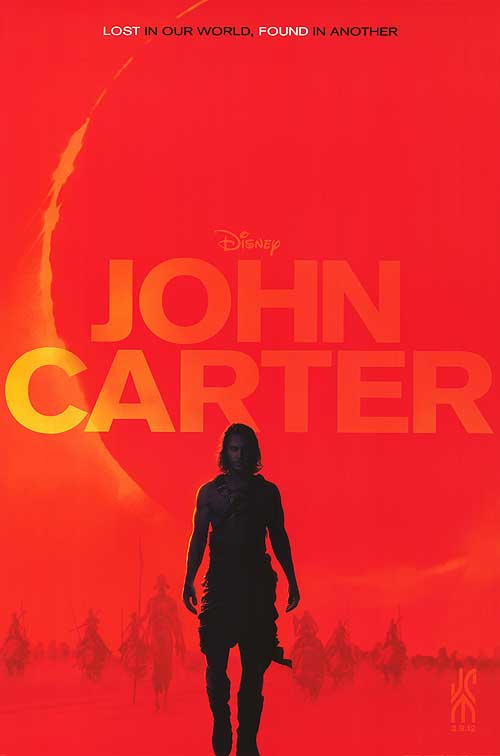
Directed By: Andrew Stanton
Cast: Taylor Kitsch, Lynn Collins, Mark Strong, Willem Dafoe, Samantha Morton, Thomas Haden Church, Ciarán Hinds, Dominic West, James Purefoy, Polly Walker, Bryan Cranston
Budget: $250 million
Runtime: 132 minutes
Trailer: Watch
John Carter (Kitsch) is a world-weary civil war veteran who goes looking for gold in the Apache territories. Upon stumbling into a cave he finds a mysterious amulet which whooshes him off to Mars - or as the natives call it, Barsoom. There Carter quickly discovers he has super strength and can leap a hundred feet into the air. He is taken in by rather primitive green martians called 'Tharks' who are caught in the middle of two warring, red-tinged humanoid factions. These are the tyrannical Zodangans and those of the last free city of Helium. When he saves the beautiful Heliumite Princess Dejah (Collins), pacifist Carter finds himself sucked into the conflict.
This is of course a shamelessly overt parallel to the 1880s Earth from which Carter just arrived, neatly summed up by the Thark leader Tars Tarkas (Dafoe) who says "let red men kill red men until only Tharks remain". The analogy is clear; the Tharks represent the Native Americans while the Zodangans and Heliumites are the Confederate and Union sides of America's civil war. But that's about as deep as this gets. The Tharks aren't being pushed out of their lands and subject to extinction by the red man, rather they're left quite to their own devices. Certainly John Carter's allegory isn't quite as poignant as the one in Cowboys & Aliens, even if it was sanitised for American audiences. While this all sounds pretty simplistic, Andrew Stanton's adaptation of Edgar Rice Burrough's novel does much to confuse its audience. There's Therns, Tharks, ninth rays and everything else therein which doesn't bode well for artistic coherence. Just what the hell is a ninth ray isolate? Who are these Therns which resemble 'the observers' from Fringe? What is their role in all this? Well, John Carter certainly won't pretend to give you the answers.
Convoluted plots aren't the only problem with John Carter. For starters some of the dialogue is pure cringe. In an appeal to Carter's emotions, Dejah emphatically begs "Will you stay and fight - for Helium?!". Later, rallying his troops, Carter cries "If Helium falls, so does Barsoom!". One can't help but wince. The battle scenes, although pretty, nonetheless feel somewhat lacklustre. They are short and to the point, but not as epic as you might expect from a film this grandiose in ambition and budget. This is particularly the case with the final showdown where one really doesn't get the impression it is the battle to decide the fate of the planet. More so, it looks and plays out like an abridged version of what went down at the end of Flash Gordon. In fact, everything in John Carter seems compressed, which is strange given its punishing runtime. This is overly long without reason, and doesn't make adequate use of the time to develop its plot strands. The result is that it remains desultory, bland and difficult to follow, emitting a peculiarly heavy feeling for a Disney action film. This isn't helped by a script which shies away from wit and lacks the fun of other Disney titles in the same bracket, namely Pirates of the Caribbean.
Indeed, most surprising of all is how extraordinarily violent this is for a Disney movie. You see, I was brought up on a diet of Aladdin and the Lion King where the clear distinction between good and evil was drawn. By the end of the movie, peace and love would always triumph and the few deaths which did happen were portrayed tactfully for their younger audiences. Here, hacking and slashing is common place in a world where there is no pussyfooting around death. In one scene after a tumultuous battle we see the victors piling corpses in a neat little stack. Is this the Disney I remember from childhood? More importantly, is this fitting for a 12A rating? While I still get a warm fuzzy feeling and an invigorated sense of hope and optimism whenever I watch a Disney film from my childhood, it is a wonder if this 'new direction' for the company is going to result in a generation desensitised to violence and shrouded in moral ambiguity.
Perhaps most disappointingly however are the film's two lead roles. Kitsch is pretty impassive for an action hero and borders on vapid. The only emotion you'll get out of him is if you attempt to restrict this man's liberty. Pray you don't, else you'll see a fully grown man morph into a toddler who literally kicks and screams until he gets his way. Despite her sexy muscular thighs, Collins isn't much more enlivening. Princess Dejah is just straight up confused. One moment a brilliant scientist, the next a fearsome warrior heroin not afraid to go balls deep, only to become your traditional ditzy damsel in distress. Unfortunately you can't be all of them, love, and it is this which makes her character unsympathetic altogether. More incredulous is the two's budding romance where within a mere five minutes the two are madly in love. It's a difficult one to swallow, especially as the two are shown to be constantly wary, tiptoeing around one another for fear of intruding on the other's space.
At least John Carter is very visually impressive. This might be expected given that Stanton, the man involved with Pixar greats such as Toy Story and Wall▪E, is at the helm. There's motion-captured Tharks, airships which resembles dragonflies and arresting vistas of a sparkling Helium. If anything else, this is stunning to look at. And it may as well be given its obscene budget of $250million, which exceeds even that of Marvel's The Avengers. However, for all its visual splendour it is everything else which lets John Carter down, which is shown in losses of $200million (£126million) due to poor box-office results. Granted, it hardly has the most awe-inspiring titles but what's more puzzling however is that for all its CGI magnificence it's difficult to tell where else this absurd amount of money has been spent on what is a very niche adaptation, even for the nerd community. John Carter stars names which skirt the periphery of Hollywood, mostly British actors who are notoriously hired based on their relative 'cheapness' vis-a-vis their American colleagues. Indeed, they are hardly paying a cohort of Brad Pitts and Angelina Jolies here.
Despite Disney ploughing enough money into John Carter to solve world hunger, the end result falls way short of expectations. At best it might be considered a passable action adventure, but a convoluted storyline, made more confusing by a bunch of absurd names do much to undermine what is otherwise an aesthetically pleasing film.

