Certificate: 12A (intense sequences of violence and action)
Directed By: Andrew Stanton
Cast: Taylor Kitsch, Lynn Collins, Mark Strong, Willem Dafoe, Samantha Morton, Thomas Haden Church, Ciarán Hinds, Dominic West, James Purefoy, Polly Walker, Bryan Cranston
Budget: $250 million
Runtime: 132 minutes
Trailer: Watch
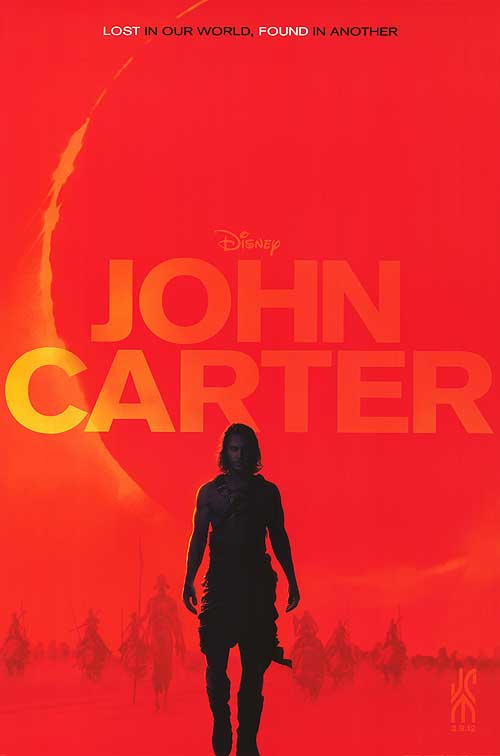
John Carter (Kitsch) is a world-weary civil war veteran who goes looking for gold in the Apache territories. Upon stumbling into a cave he finds a mysterious amulet which whooshes him off to Mars - or as the natives call it, Barsoom. There Carter quickly discovers he has super strength and can leap a hundred feet into the air. He is taken in by rather primitive green martians called 'Tharks' who are caught in the middle of two warring, red-tinged humanoid factions. These are the tyrannical Zodangans and those of the last free city of Helium. When he saves the beautiful Heliumite Princess Dejah (Collins), pacifist Carter finds himself sucked into the conflict.
This is of course a shamelessly overt parallel to the 1880s Earth from which Carter just arrived, neatly summed up by the Thark leader Tars Tarkas (Dafoe) who says "let red men kill red men until only Tharks remain". The analogy is clear; the Tharks represent the Native Americans while the Zodangans and Heliumites are the Confederate and Union sides of America's civil war. But that's about as deep as this gets. The Tharks aren't being pushed out of their lands and subject to extinction by the red man, rather they're left quite to their own devices. Certainly John Carter's allegory isn't quite as poignant as the one in Cowboys & Aliens, even if it was sanitised for American audiences. While this all sounds pretty simplistic, Andrew Stanton's adaptation of Edgar Rice Burrough's novel does much to confuse its audience. There's Therns, Tharks, ninth rays and everything else therein which doesn't bode well for artistic coherence. Just what the hell is a ninth ray isolate? Who are these Therns which resemble 'the observers' from Fringe? What is their role in all this? Well, John Carter certainly won't pretend to give you the answers.
Convoluted plots aren't the only problem with John Carter. For starters some of the dialogue is pure cringe. In an appeal to Carter's emotions, Dejah emphatically begs "Will you stay and fight - for Helium?!". Later, rallying his troops, Carter cries "If Helium falls, so does Barsoom!". One can't help but wince. The battle scenes, although pretty, nonetheless feel somewhat lacklustre. They are short and to the point, but not as epic as you might expect from a film this grandiose in ambition and budget. This is particularly the case with the final showdown where one really doesn't get the impression it is the battle to decide the fate of the planet. More so, it looks and plays out like an abridged version of what went down at the end of Flash Gordon. In fact, everything in John Carter seems compressed, which is strange given its punishing runtime. This is overly long without reason, and doesn't make adequate use of the time to develop its plot strands. The result is that it remains desultory, bland and difficult to follow, emitting a peculiarly heavy feeling for a Disney action film. This isn't helped by a script which shies away from wit and lacks the fun of other Disney titles in the same bracket, namely Pirates of the Caribbean.
Indeed, most surprising of all is how extraordinarily violent this is for a Disney movie. You see, I was brought up on a diet of Aladdin and the Lion King where the clear distinction between good and evil was drawn. By the end of the movie, peace and love would always triumph and the few deaths which did happen were portrayed tactfully for their younger audiences. Here, hacking and slashing is common place in a world where there is no pussyfooting around death. In one scene after a tumultuous battle we see the victors piling corpses in a neat little stack. Is this the Disney I remember from childhood? More importantly, is this fitting for a 12A rating? While I still get a warm fuzzy feeling and an invigorated sense of hope and optimism whenever I watch a Disney film from my childhood, it is a wonder if this 'new direction' for the company is going to result in a generation desensitised to violence and shrouded in moral ambiguity.
Perhaps most disappointingly however are the film's two lead roles. Kitsch is pretty impassive for an action hero and borders on vapid. The only emotion you'll get out of him is if you attempt to restrict this man's liberty. Pray you don't, else you'll see a fully grown man morph into a toddler who literally kicks and screams until he gets his way. Despite her sexy muscular thighs, Collins isn't much more enlivening. Princess Dejah is just straight up confused. One moment a brilliant scientist, the next a fearsome warrior heroin not afraid to go balls deep, only to become your traditional ditzy damsel in distress. Unfortunately you can't be all of them, love, and it is this which makes her character unsympathetic altogether. More incredulous is the two's budding romance where within a mere five minutes the two are madly in love. It's a difficult one to swallow, especially as the two are shown to be constantly wary, tiptoeing around one another for fear of intruding on the other's space.
At least John Carter is very visually impressive. This might be expected given that Stanton, the man involved with Pixar greats such as Toy Story and Wall▪E, is at the helm. There's motion-captured Tharks, airships which resembles dragonflies and arresting vistas of a sparkling Helium. If anything else, this is stunning to look at. And it may as well be given its obscene budget of $250million, which exceeds even that of Marvel's The Avengers. However, for all its visual splendour it is everything else which lets John Carter down, which is shown in losses of $200million (£126million) due to poor box-office results. Granted, it hardly has the most awe-inspiring titles but what's more puzzling however is that for all its CGI magnificence it's difficult to tell where else this absurd amount of money has been spent on what is a very niche adaptation, even for the nerd community. John Carter stars names which skirt the periphery of Hollywood, mostly British actors who are notoriously hired based on their relative 'cheapness' vis-a-vis their American colleagues. Indeed, they are hardly paying a cohort of Brad Pitts and Angelina Jolies here.
Despite Disney ploughing enough money into John Carter to solve world hunger, the end result falls way short of expectations. At best it might be considered a passable action adventure, but a convoluted storyline, made more confusing by a bunch of absurd names do much to undermine what is otherwise an aesthetically pleasing film.
Showing posts with label Mark Strong. Show all posts
Sunday, 27 May 2012
Monday, 21 May 2012
Film Review: Black Gold
Certificate: 12A
Directed By: Jean-Jacques Annaud
Cast: Tahar Rahim, Antonio Banderas, Mark Strong, Freida Pinto, Riz Ahmed, Liya Kebede
Budget: €40 million
Runtime: 130 minutes
Trailer: Watch
A peace is brokered between two warring Arab tribes, cemented by Amar (Strong) giving his two sons to rival Nesib (Banderas) as hostages. Years later the wary peace is perturbed by the discovery of oil. Nesib violates their treaty when he begins exploiting the riches buried beneath the agreed upon demarcation zone. Philosophical conflicts over religion, politics, tradition, progress and love are ignited.
Other than the events depicted in Lawrence Of Arabia, not a whole lot seems to be known in the West about the Arab world during the early twentieth century. In many ways then the most appealing thing about Black Gold is its mini history lesson of the Bedouin tribes removed from T.E. Lawrence's slice of the action and their rise to statehood on the Arabian peninsula. This is epitomised here when the discovery of oil triggers a clash between the case for progress, represented by Nesib, and the defence of tradition embodied in Amar. Nesib is enamoured by the material wealth that the black gold brings, as well as the tangible benefits that elevate his people's living standards to those experienced in the West. Amar on the other hand views these 'benefits' and the agendas of the West with suspicion, a threat to their culture and way of life. It's not necessarily the most mind-blowing concept, but watching it unfold is somewhat compelling as these two diametrically opposed dogmas fight over how to adjust to their new reality.
At the centre of this conflict is Amar's son Auda (Rahim), who has developed into a learned, albeit meek, young man under Nesib's custody. He falls for Nesib's daughter, Princess Leyla (Pinto), and the two are quickly wed out of love between them, and political expediency for Nesib. Raunchy sex scenes which would never make it past an Islamic film certification board ensue. More importantly Auda soon becomes central to the ideological battle Nesib and Amar are waging, his loyalty torn between his two father-figures, each determined to make use of his unique position.
While this all sounds very grandiose in its abstraction, the problems with Black Gold are in its execution. For one it suffers from serious pacing issues, particularly in the first half which bounds along at a gallop but never lingering to explore character's origins before slowing right down to the near point of tedium. The dialogue is also somewhat bromidic, delivered by a plethora of foreigners attempting their best Arabic accents in earnest. Nowhere is this more apparent than with Antonio Banderas, whose accentuated auricular enunciations become ridiculously obvious. Indeed, for all its epic allusions, it all falls short in pulling the material together effectively.
Black Gold is quite obviously a labour of love. A lot of money was spent and it shows in its high production values and incredibly vivid cinematography, the latter giving an indisputable nod to Lawrence Of Arabia in one battle sequence. While it is admittedly fascinating in many respects, particularly those with an interest in the history of the region, for all its ambitions it too frequently suffers from being trite throughout and arid for extended periods. Consequently the film spends most of its time wandering the desert in search of an oasis, which is disappointing as Black Gold should really have struck oil.
Directed By: Jean-Jacques Annaud
Cast: Tahar Rahim, Antonio Banderas, Mark Strong, Freida Pinto, Riz Ahmed, Liya Kebede
Budget: €40 million
Runtime: 130 minutes
Trailer: Watch
A peace is brokered between two warring Arab tribes, cemented by Amar (Strong) giving his two sons to rival Nesib (Banderas) as hostages. Years later the wary peace is perturbed by the discovery of oil. Nesib violates their treaty when he begins exploiting the riches buried beneath the agreed upon demarcation zone. Philosophical conflicts over religion, politics, tradition, progress and love are ignited.
Other than the events depicted in Lawrence Of Arabia, not a whole lot seems to be known in the West about the Arab world during the early twentieth century. In many ways then the most appealing thing about Black Gold is its mini history lesson of the Bedouin tribes removed from T.E. Lawrence's slice of the action and their rise to statehood on the Arabian peninsula. This is epitomised here when the discovery of oil triggers a clash between the case for progress, represented by Nesib, and the defence of tradition embodied in Amar. Nesib is enamoured by the material wealth that the black gold brings, as well as the tangible benefits that elevate his people's living standards to those experienced in the West. Amar on the other hand views these 'benefits' and the agendas of the West with suspicion, a threat to their culture and way of life. It's not necessarily the most mind-blowing concept, but watching it unfold is somewhat compelling as these two diametrically opposed dogmas fight over how to adjust to their new reality.
At the centre of this conflict is Amar's son Auda (Rahim), who has developed into a learned, albeit meek, young man under Nesib's custody. He falls for Nesib's daughter, Princess Leyla (Pinto), and the two are quickly wed out of love between them, and political expediency for Nesib. Raunchy sex scenes which would never make it past an Islamic film certification board ensue. More importantly Auda soon becomes central to the ideological battle Nesib and Amar are waging, his loyalty torn between his two father-figures, each determined to make use of his unique position.
While this all sounds very grandiose in its abstraction, the problems with Black Gold are in its execution. For one it suffers from serious pacing issues, particularly in the first half which bounds along at a gallop but never lingering to explore character's origins before slowing right down to the near point of tedium. The dialogue is also somewhat bromidic, delivered by a plethora of foreigners attempting their best Arabic accents in earnest. Nowhere is this more apparent than with Antonio Banderas, whose accentuated auricular enunciations become ridiculously obvious. Indeed, for all its epic allusions, it all falls short in pulling the material together effectively.
Black Gold is quite obviously a labour of love. A lot of money was spent and it shows in its high production values and incredibly vivid cinematography, the latter giving an indisputable nod to Lawrence Of Arabia in one battle sequence. While it is admittedly fascinating in many respects, particularly those with an interest in the history of the region, for all its ambitions it too frequently suffers from being trite throughout and arid for extended periods. Consequently the film spends most of its time wandering the desert in search of an oasis, which is disappointing as Black Gold should really have struck oil.
Monday, 16 January 2012
Film Review: Tinker Tailor Soldier Spy
Upon setting up his task force, Smiley learns 'Control' had long harboured fears of a spy within the ranks, distrusting even those in the inner circle. 'Control's' suspicions are visualised through pictures of his suspects taped to chess pieces and given code names from a nursery rhyme. 'Tinker' is the career driven Percy Alleline (Jones); 'Tailor' the mordant Bill Haydon (Firth); 'Soldier' a breviloquent Roy Bland (Hinds); 'Poor Man' persnickety Hungarian immigrant Toby Esterhase (Dencik); and finally amongst 'Control's' suspects miserable sack of spuds George Smiley himself, designated 'Beggarman'. Aptly nicknamed 'The Circus', they are the high-value pieces at the top of MI6, each operating in accordance of their assigned chess pieces in a grand game of strategy. Others such as Smiley's aide, Peter Guilliam (Cumberbatch), are soon roped into this game of cat and mouse as things become infinitely more complex and dangerous. No chess game would be complete of course without its sacrificial pawns. Mark Strong's Jim Prideaux and Tom Hardy's Ricki Tarr; men who do 'The Circus'' dirty work, complete the essential piece of the puzzle. And suddenly the game is afoot!
And some puzzle it is. Adapted from famous spy novelist John LeCarré's book of the same name, Tinker Tailor Soldier Spy ensnares its audience in a tense world of old boys clubs and mountains of dusty files. It is a merciless roller coaster of savage bureaucratic espionage and infighting, where trust is always a misnomer and nothing is ever as it seems. And for a spy film which omits the frantic rush to stop a ticking bomb or some other calamitous mayhem, there is always a very real sense of danger and foreboding. There's so much uncertainty and paranoia floating about that the subsequent climate this creates is palpably volatile. While very understated, it's also very real. You really just don't know what the next twist is, and that's frighteningly dangerous in its own right.
It's this atmosphere, buoyed by its murky seventies Cold War setting, which makes Tinker Tailor a thoroughly absorbing experience. Rather than feeling dated or stuck in bygone era, this is more a homage than an attempt to invigorate a period for the here and now. It's unashamedly grey and brown, set firmly in a place where time doesn't flow, but is frozen. The characters are also part of this forlorn tapestry where then fashionable brown and orange wallpaper reflects the ribald, exhausted looking priests of British intelligence. It's a rich, nuanced world created here by Swedish director Thomas Alfredson (Let The Right One), inviting an investment where you want to know who's doing what to whom and why. While the drab aesthetic is without doubt entrancing, it's of critical importance to heed another MI6 employee who uttered those infamous words "do pay attention double-O-seven". One must constantly concentrate throughout Tinker Tailor, a film so vast in its complexity of twists, turns, counter-twists and counter-turns that even Otto von Bismarck would be left scratching his head. Yes it's dense, difficult and depressing to follow at the best of times, but like in real spy-dom a fastidious attention to detail will yield rewards.
Where the mystery of the mole is engaging in itself, perhaps more enthralling are the nuances of the men involved. One might expect that the collective which constitute 'The Circus' would be the staunchest defenders of democracy and the Western way of life, patriotic chaps who represent the best of British. What's engrossing is how much further from this ideal these men could be. Instead we have alarmingly fallible men disillusioned and cynical of those in power who, as a consequence, are liable to becoming unprincipled traitors to those that may offer a better deal. It is a chord which would have resonated with its Cold War audience of the time, an idea that the West was a spent force and had no more to offer other than the gratification of greed - an amorality eschewed by its ascetic rivals in the East. It was a very real fear that such exotic influences could be allowed to fester at the core of society, an indolence to protect a system that offered little, yet where a failure to do so could let in something far worse. The film's ashen-grey setting of seventies London does much to enhance this feeling of a decadent West about to cave on itself. If you know the history of the period - the rise of trade unions, three-day weeks, power cuts, IMF bailouts - then you can begin to see why no one would want to invest in a nation, a system, which offered nothing. Britain wasn't alone in its problems. American reputation lay in tatters for its war in Vietnam while CIA coups brought people like Pinochet to power. At home it faced the most famous political scandal of the twentieth-century, Watergate. The seventies were very much a period that shook the central tennets of Western civilisation and while you might not think much of Tinker Tailor's archaism it is still quite possible to draw parallels to today. Once again confidence in the system has dramatically plummeted in the face of joblessness, corruption scandals and high bonuses for those who messed up in the first place. Despite being set in a world structured along fundamentally different lines, perhaps ironically this bears more relevance now than any time since.
The film's other underlying current, betrayal, is one which permeates throughout on multiple levels. From betrayal of queen and country to that of personal relationships and self, a vivid picture of the world these ringmasters live in soon emerges. Here sexuality is used to emphasise this, an issue which the book skirts over but one which Alfredson chose to add to great effect. For example, Smiley's wife Ann is shown to be a serial cheater, apportioning favours to close work colleague, Haydon. Ricki Tarr meanwhile forms a connection with a woman on a secret mission abroad, promising her a new life in the West only to fail in saving her from the torturous clutches of the KGB. Hard-as-nails field agent Jim Prideaux, best friends with Haydon since their time at an all boys school, is driven to extreme actions more becoming of a bond which supersedes friendship. But while sex does much to highlight this theme of betrayal what it shows more of is how this group of people, these intelligence deities who preside over the nation's safety and are the frontline against the threat of an international communist conspiracy are just as prone to error as anyone else. Perhaps even more so. They are mortals, as frail and susceptible to emotion as the next person, and this provides a strange yet fascinating twist for an otherwise emotionally cold film.
As one might gather, Tinker Tailor has managed to assemble a sterling ensemble of some of Britain's finest actors. Smiley wasn't the easiest role for Oldman to fill, given that LeCarré's book was made into a BBC miniseries where the character became inextricably linked with an impeccable portrayal by Alec Guinness. Indeed, so synonymous did Guinness become with the book's inscrutable protagonist that Tinker Tailor has drawn some skepticism. Oldman fortunately is superb, eerily motionless but in possession of a piercing mind as he pulls off stoicism in an amoral world of double-crossing and egotistical opportunists. He is a very British type of hero - tired, colourless, and defeated in demeanour, yet despite his nonchalance and drab appearance is a master of his trade - someone you underestimate at your peril. Cumberbatch's recent meteoric rise to fame is once again fully justified here as is another rising star, Tom Hardy, showing a versatility in a role which couldn't be further removed from his latest character, Bane, in the upcoming Dark Knight Rises. As we've come to expect from John Hurt his vitriolic 'Control' is excellent while the time travelling Colin Firth does what he does best, seamlessly blending into yet another period drama. Likewise Mark Strong, not a villain for once, yet again turns in a 'strong' performance.
In the past few years we've had the explosive antics of Bond and Bourne, but this, without any hint of things going boom or martial arts madness, could easily be considered more exciting then either of them. There's no Pussy Galore, Aston Martins fitted with ejector seats or exotic locales here - only piles of disheveled documents situated in drab London settings and dinky little caravans. It's the cerebral spy thriller, a 'whodunnit' that would test even the combined grey matter of Poirot and Marple. Admittedly it can be a little ponderous, and perhaps the biggest let down to this clever caper is its final reveal. While commendable in its lack of histrionics it is perhaps a bit too understated. However, considering this is a film inhabited by deeply flawed monomaniacs and quislings afflicted with paranoia and sociopathy, this won't stop you from being sucked into its smart and dreary world.
Sunday, 25 September 2011
Film Review: Green Lantern
A dying purple alien crash lands on Earth, his powerful ring recruiting test pilot Hal Jordan (Reynolds) to become a member of the Green Lantern Corps - a group of green intergalactic space cops. When the planet faces imminent destruction at the hands of a cosmic cloud named Parallax fuelled by the power of fear, Hal must first learn some harsh life lessons before he can save the universe.
Green Lantern is a boringly familiar origins tale of a callow, cocky young delinquent with daddy issues who is bestowed an inordinate amount of power but must first learn that with great power comes great responsibility before he can defeat the baddy at the end. Bla bla bla, nothing new here then. Hector Hammond (Sarsgaard) provides our obligatory mirror nemesis, infused with the power of fear which morphs him into Parallax's minion on Earth. However, Hector seems more of a sparing partner than a genuine threat, scarcely eliciting inspiration like a good antagonist should. This is instead left to Parallax himself, a giant amorphous CGI cloud resembling a squid which is bent on eating the universe. And yet for such a planet ending menace, which also eliminates scores of more experienced Green Lantern Corps members with ease, rookie Hal's prompt dispatch of it within five-minutes right at the end just shows how much of an afterthought the bad guys were. This is perhaps what's most disappointing, that the parts which should be exciting in a super hero movie feel rushed.
Instead we're invited to watch Hal schlepping around with super powers, the action expendable so we can witness his jejune antics in the name of character development. However, even this doesn't translate very well. Rather than showing progression from a man child suffering hypengyophobia to upstanding cosmic saviour via rooted character exploration we merely experience a sudden personality shift. And yet this whole film is so self-indulgent in Reynold's 'character' that the supporting cast don't even register, dipping in and out at will. Hal's love interest, Carol (Lively), for example is there to alternate between castigating and fawning over Hal when the mood suits. Mark Strong's Sinestro, honcho of the Corps, is perhaps the most interesting character but is likewise reasonably inconsequential. It's not so much that the actors are necessarily bad, but rather their roles suffer at the hands of a tepid script.
Like Marvel's renovation of its second-tier stars (Iron Man, Thor), Green Lantern follows in similar vain as the first of DC's reboots. But let's be honest for a second here, DC characters have never been as awesome as their Marvel counterparts. Christopher Nolan's Batman re-imagining however changed all that by giving the Dark Knight a gritty realism with a super cool sheen. If DC are feeling left out by the barrage of Marvel facelifts then perhaps they would have been better off using the same tone precedented by Nolan's Batman which might have achieved a similar 'eureka' here. Unfortunately though Green Lantern abjectly displays a comparable aesthetic and comportment to Iron Man and Spiderman, sacrificing ponderable philosophies present in the Dark Knight for a glitzier, altogether cartoonier affair. It remains interesting to see whether the Superman reboot will be more Batman or more Lantern, but with Nolan rumoured to be producing on the Man of Steel it looks like DC might get back on track. Certainly then it doesn't seem DC are gearing up to a Justice League movie in the same way Marvel have created a uniform universe in preparation for The Avengers. For now at least Green Lantern looks set to be starting its own franchise, with allusions at the end of the film for a return of a more sinister Sinestro.
All said and done however, I actually enjoyed Green Lantern more than the majority of critics would have you believe. While the above sounds like a complete chastisement of the film, it does have its perks. The CGI effects are lovely and the ring's power to bring forth "anything you can imagine" is used to good effect with some pretty originative creations. The main problem is that the origins story is usually so difficult to nail, but this is not half as terrible as some far worse efforts in recent years (step up, Ghost Rider, Elektra and Daredevil, your time has come). Yes, it's deeply flawed, more often boring than not, but there are definite flashes of brilliance in places. However, Marvel have it pegged, setting the bar with much more satisfying origins stories in the form of Iron Man, Thor and Captain America. I look to Green Lantern's sequel with curiosity.
Green Lantern is a boringly familiar origins tale of a callow, cocky young delinquent with daddy issues who is bestowed an inordinate amount of power but must first learn that with great power comes great responsibility before he can defeat the baddy at the end. Bla bla bla, nothing new here then. Hector Hammond (Sarsgaard) provides our obligatory mirror nemesis, infused with the power of fear which morphs him into Parallax's minion on Earth. However, Hector seems more of a sparing partner than a genuine threat, scarcely eliciting inspiration like a good antagonist should. This is instead left to Parallax himself, a giant amorphous CGI cloud resembling a squid which is bent on eating the universe. And yet for such a planet ending menace, which also eliminates scores of more experienced Green Lantern Corps members with ease, rookie Hal's prompt dispatch of it within five-minutes right at the end just shows how much of an afterthought the bad guys were. This is perhaps what's most disappointing, that the parts which should be exciting in a super hero movie feel rushed.
Instead we're invited to watch Hal schlepping around with super powers, the action expendable so we can witness his jejune antics in the name of character development. However, even this doesn't translate very well. Rather than showing progression from a man child suffering hypengyophobia to upstanding cosmic saviour via rooted character exploration we merely experience a sudden personality shift. And yet this whole film is so self-indulgent in Reynold's 'character' that the supporting cast don't even register, dipping in and out at will. Hal's love interest, Carol (Lively), for example is there to alternate between castigating and fawning over Hal when the mood suits. Mark Strong's Sinestro, honcho of the Corps, is perhaps the most interesting character but is likewise reasonably inconsequential. It's not so much that the actors are necessarily bad, but rather their roles suffer at the hands of a tepid script.
Like Marvel's renovation of its second-tier stars (Iron Man, Thor), Green Lantern follows in similar vain as the first of DC's reboots. But let's be honest for a second here, DC characters have never been as awesome as their Marvel counterparts. Christopher Nolan's Batman re-imagining however changed all that by giving the Dark Knight a gritty realism with a super cool sheen. If DC are feeling left out by the barrage of Marvel facelifts then perhaps they would have been better off using the same tone precedented by Nolan's Batman which might have achieved a similar 'eureka' here. Unfortunately though Green Lantern abjectly displays a comparable aesthetic and comportment to Iron Man and Spiderman, sacrificing ponderable philosophies present in the Dark Knight for a glitzier, altogether cartoonier affair. It remains interesting to see whether the Superman reboot will be more Batman or more Lantern, but with Nolan rumoured to be producing on the Man of Steel it looks like DC might get back on track. Certainly then it doesn't seem DC are gearing up to a Justice League movie in the same way Marvel have created a uniform universe in preparation for The Avengers. For now at least Green Lantern looks set to be starting its own franchise, with allusions at the end of the film for a return of a more sinister Sinestro.
All said and done however, I actually enjoyed Green Lantern more than the majority of critics would have you believe. While the above sounds like a complete chastisement of the film, it does have its perks. The CGI effects are lovely and the ring's power to bring forth "anything you can imagine" is used to good effect with some pretty originative creations. The main problem is that the origins story is usually so difficult to nail, but this is not half as terrible as some far worse efforts in recent years (step up, Ghost Rider, Elektra and Daredevil, your time has come). Yes, it's deeply flawed, more often boring than not, but there are definite flashes of brilliance in places. However, Marvel have it pegged, setting the bar with much more satisfying origins stories in the form of Iron Man, Thor and Captain America. I look to Green Lantern's sequel with curiosity.
Monday, 12 September 2011
Film Review: The Guard
Venal, partial to recreational drug use and the occasional hooker or two, Sergeant Gerry Boyle (Gleeson) isn't exactly what you'd call a conventional cop. When a seemingly random homicide is linked to a major drug deal going down in Boyle's sleepy little jurisdiction, FBI Agent Wendell Everett (Cheadle) descends on the province hoping to catch the smugglers.
The Guard sets its tone early. After a senseless car crash, Sergeant Boyle walks over to the hulking wreck and frisks the dead bodies for drugs. Drugs he proceeds to pocket for his personal use. When he struggles to find the correct terminology for a wheelchair-bound person and his colleague tells him they're called paraplegics, Boyle candidly agrees by uttering "Spastic, yeah" without a second thought. Likewise, he'll quite happily ask if black FBI agent, Everett, grew up in the projects. Where the rest of the cast wince at his political incorrectness, Boyle seems incredulous to the offence he apparently causes, innocently explaining that "I'm Irish sir. Racism is a part of me culture". However, Boyle is not a bigoted idiot; he's much more complex than that. The brilliance of Gleeson's Boyle is that the rest of the characters never quite know what to make of him. As Everett succinctly puts it "I can't tell if you're really motherfucking dumb, or really motherfucking smart". His antagonism toward Everett derives from a desire merely to push people's buttons, bemused by the absurdity of how seriously everyone else takes boring, trivial little things. Boyle is a contrarian for the sake of it, displaying a certain guile as he makes his own fun in what appears to be a method to his ignorance. As such, watching Gleeson and Cheadle spa is a delight as the two form an unusual and begrudging friendship. Throw in a philosophical drug smuggling trio who drive around the Irish countryside quoting Nietzsche and Bertrand Russell in what are shades of Tarantino and you're definitely onto a winner here.
Writer and director John Michael McDonagh is the brother of Martin McDonagh, who wrote and directed In Bruges where Brendan Gleeson was used to similarly fantastic effect. Once again Gleeson is the engine driving proceedings, a wonderful character who puts a highly unconventional spin on a conventional buddy mismatch and cop formula. Cheadle's by-the-book Agent Everett is the perfect foil to Boyle who's incredulous to his antics, their relationship providing the main source of comic entertainment. While you do wish that such a big name would have a few more witty lines in him, the gravitas Cheadle brings to the film more than compensates. The hyper-learned criminals lead by Liam Cunningham who the duo seek to apprehend are equally enjoyable, Mark Strong and David Wilmot making the most of their secondary villainous roles. As if to reinforce the idea that no one is sacred, even the Irish are portrayed in their stereotype as 'stupid', with Strong there as an Englishman used to highlight their imbecilely.
The Guard is sort of like the Irish version of Hot Fuzz, sporting the same dark comic tone of In Bruges. Indeed, the Irish brand of humour is particularly unique, a deliverance of dead pan flippancy with a twinkle in the eye which cares not who it offends. Only the ever effusive charm of the Irish could get away with such barbed and politically incorrect humour. The dialogue is delightfully capricious, sharp in a rata-tat-tat manner and eminently quotable. If you get it, The Guard is fucking funny. If not, the PC brigade will probably have a fit. This is what Hot Fuzz should have been.
The Guard sets its tone early. After a senseless car crash, Sergeant Boyle walks over to the hulking wreck and frisks the dead bodies for drugs. Drugs he proceeds to pocket for his personal use. When he struggles to find the correct terminology for a wheelchair-bound person and his colleague tells him they're called paraplegics, Boyle candidly agrees by uttering "Spastic, yeah" without a second thought. Likewise, he'll quite happily ask if black FBI agent, Everett, grew up in the projects. Where the rest of the cast wince at his political incorrectness, Boyle seems incredulous to the offence he apparently causes, innocently explaining that "I'm Irish sir. Racism is a part of me culture". However, Boyle is not a bigoted idiot; he's much more complex than that. The brilliance of Gleeson's Boyle is that the rest of the characters never quite know what to make of him. As Everett succinctly puts it "I can't tell if you're really motherfucking dumb, or really motherfucking smart". His antagonism toward Everett derives from a desire merely to push people's buttons, bemused by the absurdity of how seriously everyone else takes boring, trivial little things. Boyle is a contrarian for the sake of it, displaying a certain guile as he makes his own fun in what appears to be a method to his ignorance. As such, watching Gleeson and Cheadle spa is a delight as the two form an unusual and begrudging friendship. Throw in a philosophical drug smuggling trio who drive around the Irish countryside quoting Nietzsche and Bertrand Russell in what are shades of Tarantino and you're definitely onto a winner here.
Writer and director John Michael McDonagh is the brother of Martin McDonagh, who wrote and directed In Bruges where Brendan Gleeson was used to similarly fantastic effect. Once again Gleeson is the engine driving proceedings, a wonderful character who puts a highly unconventional spin on a conventional buddy mismatch and cop formula. Cheadle's by-the-book Agent Everett is the perfect foil to Boyle who's incredulous to his antics, their relationship providing the main source of comic entertainment. While you do wish that such a big name would have a few more witty lines in him, the gravitas Cheadle brings to the film more than compensates. The hyper-learned criminals lead by Liam Cunningham who the duo seek to apprehend are equally enjoyable, Mark Strong and David Wilmot making the most of their secondary villainous roles. As if to reinforce the idea that no one is sacred, even the Irish are portrayed in their stereotype as 'stupid', with Strong there as an Englishman used to highlight their imbecilely.
The Guard is sort of like the Irish version of Hot Fuzz, sporting the same dark comic tone of In Bruges. Indeed, the Irish brand of humour is particularly unique, a deliverance of dead pan flippancy with a twinkle in the eye which cares not who it offends. Only the ever effusive charm of the Irish could get away with such barbed and politically incorrect humour. The dialogue is delightfully capricious, sharp in a rata-tat-tat manner and eminently quotable. If you get it, The Guard is fucking funny. If not, the PC brigade will probably have a fit. This is what Hot Fuzz should have been.
Tuesday, 19 April 2011
Film Review: The Eagle
Romans. The Americans of their day, sporting a vast Empire across the known world. It perhaps only fitting then to give all the Romans in The Eagle an American accent. It's hardly subtle in its deliberate allegory, similar to that when Hollywood casts Brits in roles of villains as some sort of parallel with the American Revolution, but it is annoying in the sense that it detracts from the 'period feel' of ancient Rome. Certainly, I found it difficult to get that distracting little voice out of my head which was screaming throughout the film "Yanks!". But then I suppose we couldn't have Americans playing the oppressed peoples of the British Isles under Rome's yoke. That would have been too ridiculous...
When Marcus Flavius Aquila (Tatum), a young centurion bent on restoring his family's honour after his father lead an ill-fated expedition of the Ninth Legion, is permanently incapacitated within a day of his first command, he finds himself milling away his days around his Uncle's (Sutherland) villa after an honourable discharge. After saving a British slave named Esca (Bell) from death in a gladiatorial arena, the two form a bond and embark on a mission to retrieve his father's Ninth Legion standard, a golden eagle rumoured to be in the possession of a vicious tribe north of Hadrian's Wall.
The Eagle is based on a 1954 novel by by Rosemary Sutcliff called The Eagle of the Ninth. Part fact, part fiction, it is based around the myth surrounding the Legio IX Hispana, a Roman legion which was rumoured to have been destroyed by Caledonian tribes in AD 117. Since its publication however new historical evidence has come to light that the Ninth Legion was not in fact destroyed in Scotland, with records showing that elements of the Ninth were actually posted along the Rhine after AD 117. Further, the actual golden eagle upon which the story is based, housed in a museum in Reading, is not that of a Legion's standard but that of a Jupiter statue in the forum of the Roman town. As such, as a 'historical epic', The Eagle suffers from the advances made in historical study, making the film less fact and more fiction.
The Eagle starts off with a bang as the fresh faced Aquila faces an assault on his new command in the opening minutes. We are introduced to Roman fighting tactics such as the 'tortoise' in brutal fashion, with the shaky, gritty, close-up action shots we've come to expect from films set in the ancient world. It sets a good tone for an exhilarating film and the action scenes do indeed remain consistent throughout. But the problem is the bits in between which feel disjointed from the action scenes. Essentially, The Eagle amounts to a mismatched buddy movie. It follows the formula where two people who couldn't be any different from one another are thrown together for whatever reason, and, over a series of events, are able to bond and surmount those differences where by the end the two will have developed a bemusing friendship. Sure, this is the end result of The Eagle, but it is the 'how' which is missing as the film sort of stumbles along. We are treated to bits where the two bond, but the developing friendship is never actually transmitted. As such Esca's actions appear particularly odd and the whole relationship becomes a sympathetic fallacy. Director Kevin Macdonald does interestingly try to create a juxtaposition of scenery with Roman occupied Southern Britain bathed in sunlight, covered in vine leaves with the harsh, barren, windswept highlands of the North in an attempt to show the contrast between civilization and barbary. However, you can't help but smirk if you've ever experienced the tenuous British summer.
Historically inaccurate, made all the more jarring by American accents, and bogged down by a plot based around a peculiarly dysfunctional, robotic relationship, this film is substantially less epic than the trailers would have you believe. Unfortunately, The Eagle never really finds flight.
When Marcus Flavius Aquila (Tatum), a young centurion bent on restoring his family's honour after his father lead an ill-fated expedition of the Ninth Legion, is permanently incapacitated within a day of his first command, he finds himself milling away his days around his Uncle's (Sutherland) villa after an honourable discharge. After saving a British slave named Esca (Bell) from death in a gladiatorial arena, the two form a bond and embark on a mission to retrieve his father's Ninth Legion standard, a golden eagle rumoured to be in the possession of a vicious tribe north of Hadrian's Wall.
The Eagle is based on a 1954 novel by by Rosemary Sutcliff called The Eagle of the Ninth. Part fact, part fiction, it is based around the myth surrounding the Legio IX Hispana, a Roman legion which was rumoured to have been destroyed by Caledonian tribes in AD 117. Since its publication however new historical evidence has come to light that the Ninth Legion was not in fact destroyed in Scotland, with records showing that elements of the Ninth were actually posted along the Rhine after AD 117. Further, the actual golden eagle upon which the story is based, housed in a museum in Reading, is not that of a Legion's standard but that of a Jupiter statue in the forum of the Roman town. As such, as a 'historical epic', The Eagle suffers from the advances made in historical study, making the film less fact and more fiction.
The Eagle starts off with a bang as the fresh faced Aquila faces an assault on his new command in the opening minutes. We are introduced to Roman fighting tactics such as the 'tortoise' in brutal fashion, with the shaky, gritty, close-up action shots we've come to expect from films set in the ancient world. It sets a good tone for an exhilarating film and the action scenes do indeed remain consistent throughout. But the problem is the bits in between which feel disjointed from the action scenes. Essentially, The Eagle amounts to a mismatched buddy movie. It follows the formula where two people who couldn't be any different from one another are thrown together for whatever reason, and, over a series of events, are able to bond and surmount those differences where by the end the two will have developed a bemusing friendship. Sure, this is the end result of The Eagle, but it is the 'how' which is missing as the film sort of stumbles along. We are treated to bits where the two bond, but the developing friendship is never actually transmitted. As such Esca's actions appear particularly odd and the whole relationship becomes a sympathetic fallacy. Director Kevin Macdonald does interestingly try to create a juxtaposition of scenery with Roman occupied Southern Britain bathed in sunlight, covered in vine leaves with the harsh, barren, windswept highlands of the North in an attempt to show the contrast between civilization and barbary. However, you can't help but smirk if you've ever experienced the tenuous British summer.
Historically inaccurate, made all the more jarring by American accents, and bogged down by a plot based around a peculiarly dysfunctional, robotic relationship, this film is substantially less epic than the trailers would have you believe. Unfortunately, The Eagle never really finds flight.
Thursday, 9 September 2010
Film Review: Robin Hood
I've lost count of the number of Robin Hood takes there are out there. But one thing is for sure, the Disney version remains the best. Such are the number of tales surrounding the green caped crusader who stole from the rich and gave to the poor that I am now unsure which is the most accurate. While the character of Robin Hood does indeed maintain a historical basis, he is for all intents and purposes a myth along the lines of King Arthur. And such is this that his story is malleable to many different interpretations. Thus, I looked expectantly toward Ridley Scott and Russell Crowe's continuing love affair and their latest portrayal of the man in tights.
As far as in comparison to Kevin Costner's version and those shitty BBC renditions, Scott's take is by far the most believable. At the turn of the thirteenth century Richard Lionheart returns from the Crusades, rampaging through France to get back to England. After he is slain in battle, by a French cook no less, his right-hand Knight, Sir Robert Loxley, is tasked with returning the news, and the crown, back to London. When Loxley is ambushed by the nefarious double-agent working for France, Godfrey (Mark Strong), it falls upon yeoman Robin Longstride (Crowe) to return both the crown to morally bankrupt Prince John (Isaac) and Loxley's sword to his father in Nottingham. There, coaxed into pretending to be Sir Walter Loxley's son returned from the Crusades, Robin finds himself embroiled in a struggle for power over England as he comes to tackle the evil French plot abetted by Godfrey.
Crowe offers a highly refreshing spin on the tale of Robin Hood, much like that of Robert Downey Jnr's take on Sherlock Holmes last year. This, like Holmes, is both entertaining and fun without being patronising. Crowe's Hood is a sombre character, humble to the core and devastatingly honest, indeed embodying many of the traits we've come to visualise in the man in tights. As King Richard (Huston) aptly puts it; "Honest, brave and naive. There's an Englishman". Rather than being an overly complex character, Crowe's Robin displays a very distinct view of right and wrong. That is however not to say he is a simplistic man, but that his simple ideals amount to an admirable personal moral code.
Perhaps peculiarly there is less emphasis on the traditional bad guys that the 'mainstream' versions of Robin Hood tell. While Prince John and the Sheriff of Nottingham (Macfayden) are present, they do not command the same villainous presence of Strong's Godfrey. Isaac funnily enough looks much like the Disney version of Prince John, but rather than necessarily being an evil tyrant by design he is, rather, an ignorant, decadent and incapable figure who is thrust into a leadership role without commanding the necessary skill set. Clinging to the old ways of believing his position to be granted through divine right, we are lead to believe that the events that take place in the film are the prelude to the signing of the Magna Carta. Likewise, the Sheriff of Nottingham is effectively sidelined, and when he is present is portrayed merely as an opportunistic, if not incompetent pawn rather than anything particularly sinister. Indeed, the villainy is left to the character of Godfrey and naturally, those bloody French. Mark Strong seems to be making quite a name for himself in Hollywood as the go-to-guy if you want a villain. First, Lord Blackwood in Sherlock Holmes, then Frank D'Amico in Kick-Ass and now this. He has also just finished filming playing Sinestro, an enemy of the Green Lantern. Strong does not disappoint, acting as a convincingly enjoyable baddy whom you are just willing to get his comeuppance.
That is not to say that Robin Hood is flawless. The plot becomes somewhat bogged down in places and even the climactic battle on the beach spares us any images of blood in order to fit within its 12A rating. This is also an origins story, so by the time Robin and his merry men settle down in Sherwood Forest to carry out their vigilante duties the film ends. What also seemed a little bit silly to me was the idea as to where Robin gathered his merry men from. Throughout the film we are treated to the idea of basically the twelfth century equivalent of chavs, running amok in the woods wearing masks and 'jacking' Nottingham by night. We later find out they are some sort of synonym to Peter Pan's 'lost boys', whereby Robin takes them under his wing.
Other than that this is a very enjoyable movie, if not slightly long at a run time of two-hours twenty-minutes. It definitely leaves the door open for a sequel given that it is an origins story, but it feels very much like a Braveheart for the English. If only Mel Gibson had played Godfrey his eventual comeuppance would have been that much more satisfying.
As far as in comparison to Kevin Costner's version and those shitty BBC renditions, Scott's take is by far the most believable. At the turn of the thirteenth century Richard Lionheart returns from the Crusades, rampaging through France to get back to England. After he is slain in battle, by a French cook no less, his right-hand Knight, Sir Robert Loxley, is tasked with returning the news, and the crown, back to London. When Loxley is ambushed by the nefarious double-agent working for France, Godfrey (Mark Strong), it falls upon yeoman Robin Longstride (Crowe) to return both the crown to morally bankrupt Prince John (Isaac) and Loxley's sword to his father in Nottingham. There, coaxed into pretending to be Sir Walter Loxley's son returned from the Crusades, Robin finds himself embroiled in a struggle for power over England as he comes to tackle the evil French plot abetted by Godfrey.
Crowe offers a highly refreshing spin on the tale of Robin Hood, much like that of Robert Downey Jnr's take on Sherlock Holmes last year. This, like Holmes, is both entertaining and fun without being patronising. Crowe's Hood is a sombre character, humble to the core and devastatingly honest, indeed embodying many of the traits we've come to visualise in the man in tights. As King Richard (Huston) aptly puts it; "Honest, brave and naive. There's an Englishman". Rather than being an overly complex character, Crowe's Robin displays a very distinct view of right and wrong. That is however not to say he is a simplistic man, but that his simple ideals amount to an admirable personal moral code.
Perhaps peculiarly there is less emphasis on the traditional bad guys that the 'mainstream' versions of Robin Hood tell. While Prince John and the Sheriff of Nottingham (Macfayden) are present, they do not command the same villainous presence of Strong's Godfrey. Isaac funnily enough looks much like the Disney version of Prince John, but rather than necessarily being an evil tyrant by design he is, rather, an ignorant, decadent and incapable figure who is thrust into a leadership role without commanding the necessary skill set. Clinging to the old ways of believing his position to be granted through divine right, we are lead to believe that the events that take place in the film are the prelude to the signing of the Magna Carta. Likewise, the Sheriff of Nottingham is effectively sidelined, and when he is present is portrayed merely as an opportunistic, if not incompetent pawn rather than anything particularly sinister. Indeed, the villainy is left to the character of Godfrey and naturally, those bloody French. Mark Strong seems to be making quite a name for himself in Hollywood as the go-to-guy if you want a villain. First, Lord Blackwood in Sherlock Holmes, then Frank D'Amico in Kick-Ass and now this. He has also just finished filming playing Sinestro, an enemy of the Green Lantern. Strong does not disappoint, acting as a convincingly enjoyable baddy whom you are just willing to get his comeuppance.
That is not to say that Robin Hood is flawless. The plot becomes somewhat bogged down in places and even the climactic battle on the beach spares us any images of blood in order to fit within its 12A rating. This is also an origins story, so by the time Robin and his merry men settle down in Sherwood Forest to carry out their vigilante duties the film ends. What also seemed a little bit silly to me was the idea as to where Robin gathered his merry men from. Throughout the film we are treated to the idea of basically the twelfth century equivalent of chavs, running amok in the woods wearing masks and 'jacking' Nottingham by night. We later find out they are some sort of synonym to Peter Pan's 'lost boys', whereby Robin takes them under his wing.
Other than that this is a very enjoyable movie, if not slightly long at a run time of two-hours twenty-minutes. It definitely leaves the door open for a sequel given that it is an origins story, but it feels very much like a Braveheart for the English. If only Mel Gibson had played Godfrey his eventual comeuppance would have been that much more satisfying.
Labels:
Cate Blanchett,
Mark Strong,
Oscar Isaac,
Ridley Scott,
Robin Hood,
Russell Crowe
Subscribe to:
Posts (Atom)


